What Happens When a Platform Controls Access to Opportunities?
Every creator has felt at some point that quiet, frustrating sense of waiting. Waiting for an algorithm to decide whether their work gets seen. Waiting for a reply to a cold DM sent to a brand. Waiting for someone in their network to vouch for them, because a resume or a portfolio alone wasn't enough to open the door.
Somewhere in the last decade, "opportunity" stopped being purely a function of talent, effort, and timing. It became mediated. Between an artist and a booking, a creator and a brand deal, a performer and a stage, there is now almost always a platform deciding who is visible, who is discoverable, and who gets left in the scroll.
That raises a question worth sitting with: what actually happens when a platform controls access to opportunity? Does it level the field, or does it just build a new, more invisible hierarchy?
The Quiet Power of the Gatekeeper
Platforms rarely announce themselves as gatekeepers. They present themselves as connectors to "network," "showcase," or "grow an audience." But the mechanics underneath tell a different story. Visibility on most large platforms is governed by engagement-driven ranking systems that reward whoever is already winning attention, not necessarily whoever is most skilled or most suited for a role.
For a working artist, musician, editor, or performer, this creates a strange paradox. The platform promises access to opportunity, but the actual pathway to that opportunity is often opaque, inconsistent, and shaped by factors that have little to do with craft—follower count, algorithmic favor, or simply who a person already knows. Talent becomes necessary but not sufficient. Understanding the platform becomes a real skill.
Why This Cuts Deeper in India's Creator Economy
India's media and entertainment industry is expanding fast, driven by OTT platforms, influencer marketing, live events, and an explosion of independent content creation. Yet much of the hiring and booking that powers this industry still happens the old way—through personal networks, WhatsApp forwards, unverified middlemen, and scattered, informal channels.
That fragmentation has a real cost. Brands struggle to find verified talent quickly. Agencies waste time chasing availability. And artists—from performers and DJs to editors, technicians, and influencers—often lose out on work simply because they weren't in the right group chat at the right time, not because they lacked skill. When access to opportunity depends heavily on informal proximity, the industry ends up excluding far more talent than it includes.
Two Ways a Platform Can Answer That Question
Broadly, platforms that sit between talent and opportunity tend to fall into one of two categories.
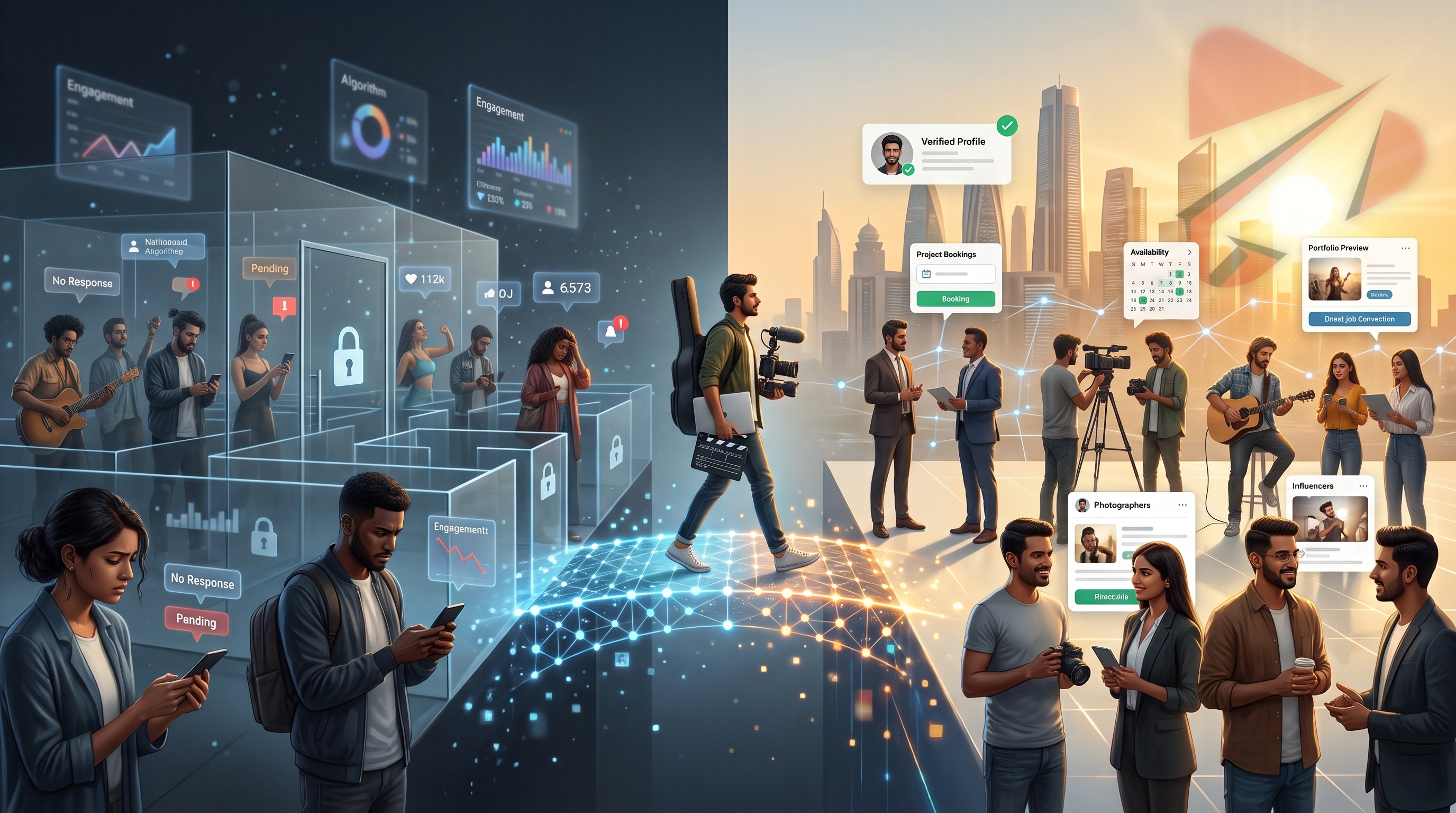
The first is the attention platform built primarily to maximize engagement and time spent, where discovery is a byproduct of an algorithm optimizing for something other than a genuine, verified match between talent and need. Opportunity flows to whoever the system favors that week.
The second is the infrastructure platform built specifically to organize a fragmented market, verify who's actually on it, and connect real supply with real demand as directly as possible. Here, the platform's job isn't to hold attention hostage; it's to get out of the way once a genuine match is made.
This is precisely the model GigMedia, a platform built by HKI Media, has set out to build for India's creative economy. Rather than functioning as a feed to scroll, GigMedia positions itself as a working ecosystem connecting artists, performers, influencers, agencies, brands, production houses, and OTT platforms on a single, verified network. Profiles are built around real portfolios and demonstrated skills. Brands and agencies can post jobs and projects directly and filter for the right fit, instead of relying on word-of-mouth. Performers get a smart availability calendar so bookings don't collapse into messaging chaos. Even celebrity bookings, traditionally layered with middlemen, are designed to happen through direct, manager-controlled, verified requests. With a growing base of tens of thousands of artists and media professionals already on the platform, the goal isn't to control who gets seen, it's to make sure that anyone with real, verifiable skill can be found.
That distinction—infrastructure versus gatekeeping—is really a distinction in intent. A platform can either sit on top of an industry and decide who rises, or it can sit underneath an industry and simply make sure the right people can find each other.
Building the Whole Pipeline, Not Just an App
What makes this a more interesting case study is that GigMedia isn't operating in isolation. It's one part of a broader effort by HKI Media, a Gurugram-based media-tech company, to rebuild the infrastructure of India's creator economy from the ground up—not just the hiring layer, but the entire pathway from learning a skill to earning from it.
Alongside GigMedia, HKI Media runs GigQuest, focused on talent discovery and connecting people to opportunity beyond just bookings; ICASA (Indian Centre for Arts, Skills & Advancement), its skilling and talent-development arm built around moving people from training into real, paid work; and HKI Studio, which handles content production and creative execution. HKI Media has also announced plans for a ₹10 crore Centre of Excellence for AVGC-XR (Animation, VFX, Gaming, Comics, and Extended Reality) in Haryana, aimed at supporting research, startups, and original IP creation in the state's creative technology sector. In Uttar Pradesh, it has partnered with the state's CM Yuva Udyami Yojana to help set up hundreds of AVGC-XR studios, giving young entrepreneurs government-backed credit alongside guaranteed access to real work through the GigMedia app.
Taken together, this isn't a single app trying to disrupt hiring. It's an attempt to rebuild every layer where a young creator in India might otherwise get stuck—training, discovery, verification, and paid work—so that fewer people are filtered out simply because they didn't have the right connections.
So, What Happens?
The honest answer is: it depends entirely on how the platform is built. A platform that controls access to opportunity through an opaque, engagement-driven algorithm will concentrate power in ways that are hard to see and harder to challenge. A platform that controls access by verifying real skill, enabling direct connections, and removing unnecessary middlemen does something very different: it redistributes opportunity instead of hoarding it.
As India's creator economy continues to scale, that difference will matter more, not less. The platforms that earn trust will likely be the ones that treat themselves not as the destination, but as the infrastructure quietly making sure that talent, wherever it comes from, has a real shot at being found.
Conclusion
GigMedia is a talent booking platform built by HKI Media, connecting artists, performers, creators, agencies, and brands across India's media and entertainment industry.